Horizontal Aid Climbing
Overview
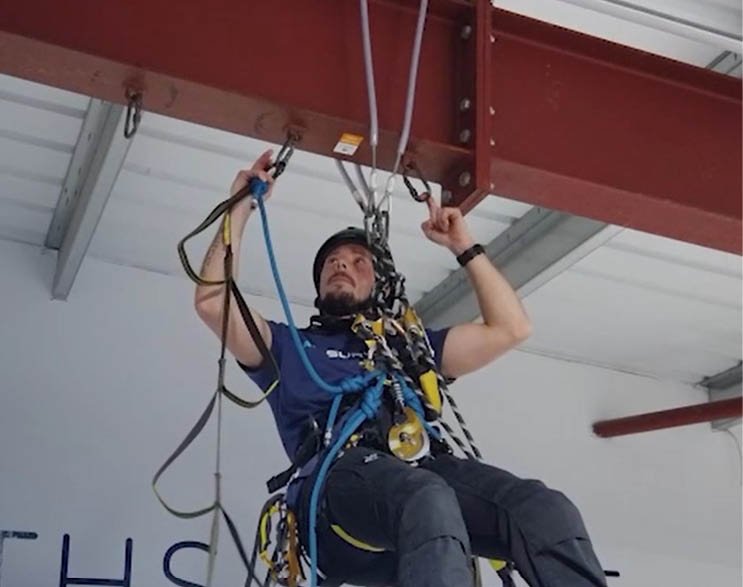
Aid climbing is a method of climbing used for progression, horizontally along or around anchors as opposed to the vertical position-ing that a set of ropes typically provides. A common method used for aid climbing would involve the use of work positioning lanyards (often cow’s tails) as direct attach-ments to the anchor, and two foot loops or etriers which are to aid the technician in manoeuvring bodyweight whilst climbing.
Horizontal aid climbing can be broken gen-erally into two categories; fixed anchor and mobile anchor. An example of fixed anchor aid climbing would be the use of drilled eyebolts in a structure as anchor points. An example of mobile anchors for aid climbing would be the use of wire or nylon anchor slings used as anchors to the structure.
This exercise will involve completing 5 meters of fixed anchor aid climbing and 5 meters of mobile anchor aid climbing - additionally, when mobile aid climbing it is necessary to demonstrate passing two obstructions.
Important Considerations
-
Is aid climbing a suitable method of access for the task?
-
Are the anchors suitable?
-
Is there sufficient equipment to safely carry out aid climbing?
-
Is the harness set up correctly for aid climbing?
-
Fall factors and impact forces should be considered
-
The difficulty of rescue should be considered
-
Access/egress to and from the aid climb should be assessed
See image for a guide to aid climbing harness set up.
Method
Fixed anchor aid climbing
-
Ascend to the knots at the top of the ropes leading to fixed anchors – take care not to push your hand or chest ascender too close to a knot as this can make it difficult to remove later
-
If you are not close enough to the anchors to begin attaching your lanyards, remove the hand ascender and foot loop from the working line and anchor the foot loop somewhere higher
-
Step in the foot loop and bring the chest ascender close to the top of the working line
-
Once close enough to the anchors, attach all three lanyards (cow’s tails) to the fixed anchors – ensure that you have a minimum of two independent attachments to the aid climb!
-
Ensure all karabiners on the aid climb anchors are secured
-
Use the foot loops or etriers to lift your bodyweight off the chest ascender, remove it from the working line and attach to the centre cow’s tail (the one you wish to be your short connection)
-
Remove the back-up device from the working line
-
Take a moment to get comfortable on the aid climb, and make any adjustments necessary to ensure you have:
-
Enough Slack in lead and trailing cow’s tails to easily unclip and move between anchors
-
Enough slack on your centre cow’s tail to unclip and move between anchors
-
Your feet are positioned high enough in the foot loops to remove your weight from the short connection when stood up in them
-
Legs resting inside the etriers – this will provide stability when standing in them
- You can now proceed to aid climb using fixed anchors, ensure that connectors are secured each time they are connected, and that you move cow’s tails in an order that will ensure you remain on two independentattachments at all times.
Note: Two cow’s tails connected to a single anchor is only one point of attachment!
Mobile anchor aid climbing
-
Follow steps 1-3 of fixed anchor aid climb method
-
Once close enough to the anchor, attach all 3 wire anchor slings and secure the karabiners
-
Now attach a cow’s tail to each wire anchor sling
-
Using your foot loops, lift your body weight to remove the chest ascender from the working line and attach to the centre cow’s tail
-
Disconnect the back-up device from the back up line
-
Take time to adjust the height of your centre cow’s tail length and foot placement to allow you to move efficiently
-
To progress, make sure you are not applying weight to the lead leg cow’s tail and slide it forward on the anchor
-
Holding the anchor, or wire slings for support, use the foot loops to lift your weight off the middle cow’s tail and slide forward
-
Now slide the trailing cow’s tail toward the centre cow’s tail
-
To continue progression, repeat steps 7-9
Passing obstructions while mobile aid climbing
-
Take the karabiner of the leading wire anchor sling, and unclip one eye of the wire sling from the karabiner
-
Move the wire anchor sling past the obstruction, connect the eye back into the karabiner and screw up
-
Now using the foot loops, lift your weight from the centre cow’s tail, remove the cow’s tail karabiner from the wire sling and connect it to the leading wire sling karabiner – take care to screw it up
-
Take the empty wire anchor sling from the middle and attach it ahead of the leading wire anchor sling that is past the obstruction and move the leading cow’s tail into it – securing the karabiner
-
For the trailing cow’s tail follow the same process detailed in steps 1-2
-
All three cow’s tails and wire slings are now past the obstruction